

China Top HPMC Factory Jinji for Tile Adhesive, Wall Putty, Dry Mix Mortar and Daily Chemical Formulations

China Top HPMC Factory - Jinji
Hydroxypropyl Methyl Cellulose
JINJI's HPMC
From Hebei to the World: The Production Power Behind JINJI CHEMICAL
JINJI CHEMICAL operates with a daily production capacity of 80 tons, supporting an annual output exceeding 30,000 tons of specialty chemical products. That volume is not simply a headline figure — it directly underpins the supply reliability that large-volume buyers require. Whether a customer is sourcing container-load quantities for a Southeast Asian dry mix mortar plant or smaller trial volumes for a Middle East coatings formulator, JINJI CHEMICAL's production infrastructure is sized to respond without lead time uncertainty.
The manufacturing process reflects the same attention to consistency. From raw material preparation and cotton linter processing through alkali treatment, etherification, neutralization, purification, drying, and final quality testing, every stage is governed by a strict internal quality control system. Batch-to-batch uniformity in viscosity, moisture content, and substitution degree is the baseline expectation — not an exception reserved for premium orders.
Today, JINJI products reach customers across more than 30 countries and regions, spanning Southeast Asia, the Middle East, Africa, South America, and Europe. That geographic breadth has required the company to stay aligned with varied regional construction standards, formulation preferences, and regulatory environments — a practical form of technical expertise that goes beyond laboratory data sheets.
One Supplier, Every Additive You Need: JINJI CHEMICAL's Full Product Lineup
HPMC: From 400 to 200,000 mPa.s — A Grade for Every Formulation
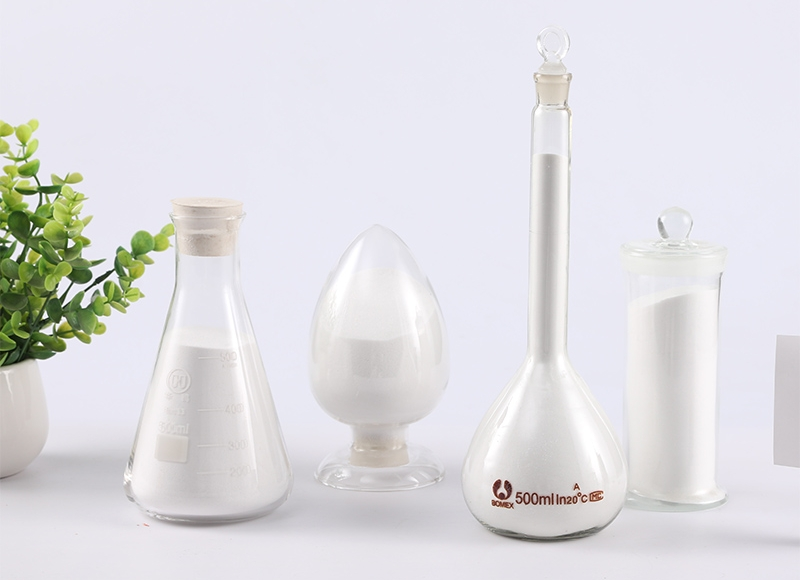
Hydroxypropyl Methyl Cellulose (HPMC), CAS No. 9004-65-3, is the foundation of JINJI's portfolio. It is a non-ionic, white to off-white powder derived from refined cotton linters, carrying a hydroxypropyl content of 4%–12% and methoxy content of 19%–24%. In aqueous solution, it functions simultaneously as a thickener, water retention agent, binder, film-former, and emulsifier — a functional profile that explains its adoption across construction, coatings, and personal care industries alike.
JINJI's HPMC is produced across three application-targeted grade categories. Construction Grade covers the full range of dry mix mortar and masonry applications. Daily-Chemical Grade is formulated for detergents, liquid soaps, shampoos, and related consumer products. Water-Based Paints & Coatings Grade is optimized for latex paints, emulsion coatings, and texture finishes. Across all three, viscosity spans from 400 mPa.s up to 200,000 mPa.s (NDJ method), with water retention between 90% and 98% and gel temperature controlled at 65°C–75°C. Where standard grades do not precisely match a customer's formulation target, OEM customization by viscosity, substitution degree, and particle size is fully supported.
MHEC/HEMC: The Right Cellulose Ether for Sprayed Mortar Markets
Methyl Hydroxyethyl Cellulose (MHEC/HEMC) is a widely used cellulose ether for dry-mix mortar applications in the Middle East and Africa. It is often selected as a practical alternative to HPMC due to its stable viscosity, reliable water retention, and strong adaptability to hot and dry climates.
JINJI's MHEC line spans construction, daily-chemical, and coatings grades. In the Middle East, it is especially suitable for sprayed mortar (machine-applied plaster), providing excellent pumpability, sprayability, and sag resistance while reducing rebound and improving on-site efficiency. For gypsum-based systems, MHEC enhances workability, extends open time, and reduces cracking risk.
For exporters and manufacturers working with EN-standardized formulations, MHEC is typically the more direct technical fit — and as a global leading MHEC supplier, JINJI CHEMICAL brings the grade range and application depth to match.
HEC: The Clean-Label Thickener for Paints, Shampoos, and Beyond
Hydroxyethyl Cellulose (HEC) is offered in daily-chemical and oil drilling & drilling fluid grades. In water-based paint systems, HEC functions as a non-ionic thickener with broad pH compatibility and clean additive compatibility. In personal care formulations, it delivers stable viscosity building in shampoos, body washes, and conditioning products without introducing ionic interference — a key advantage for formulators working to clean-label or mild-formula standards.
RDP + HPMC: The Additive Pairing That Makes Mortar Perform
JINJI's Redispersible Polymer Powder (RDP) line encompasses four types — General, Flexible, Rigid, and Hydrophobic — each engineered to address a specific mortar performance requirement. When combined with HPMC or MHEC in tile adhesive, wall putty, or EIFS/ETICS basecoat formulations, RDP contributes improved tensile adhesion, enhanced flexibility under thermal cycling, and better crack resistance in the cured mortar. The two product categories are frequently specified together precisely because their performance contributions are complementary rather than overlapping.
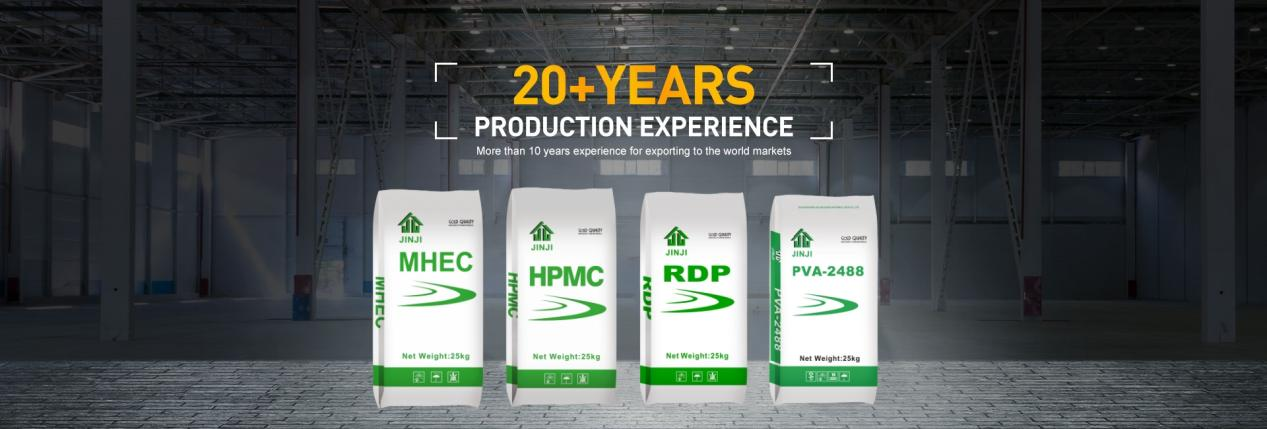
Beyond cellulose ethers and RDP powder, the portfolio also includes Hydroxypropyl Starch Ether (HPS), Polycarboxylate Superplasticizer (PCE), Carboxymethyl Cellulose (CMC), and Polypropylene Fiber (PP Fiber) — allowing dry mix mortar producers to consolidate multiple additive sourcing needs under a single, reliable supplier relationship.
Where JINJI HPMC Actually Gets to Work
Tile Adhesive: Water Retention, Open Time, and Anti-Slip — All in One Additive
In tile adhesive systems, HPMC addresses three interdependent performance requirements. Water retention slows moisture loss from the wet adhesive layer, preserving the hydration environment cement needs to develop full bond strength. Viscosity and anti-slip behavior raise the adhesive to the consistency required for controlled spreading, and prevent tiles from sliding on vertical surfaces after placement. Open time management slows surface skinning, giving installers a workable window to reposition tiles without compromising the final bond. High-viscosity grades in the 150,000–200,000 mPa.s range are typically specified for C2 and C2TE class systems — and as a professional HPMC manufacturer with dedicated construction grades, JINJI CHEMICAL is well-positioned to support these formulation requirements.
Wall Putty and Skim Coat: Smoother Application, Fewer Cracks, Better Finish
Wall putty and skim coat formulations benefit from HPMC across several performance dimensions. Workability improves substantially — the material spreads more evenly and allows the applicator to achieve a flat surface with less reworking. Shrinkage during drying is reduced, directly limiting crack formation as the coating cures. HPMC's film-forming behavior also contributes surface water resistance in the finished layer. For gypsum-based skim coat systems, JINJI's dedicated construction grades are matched to the specific setting kinetics and water demand of gypsum binders, providing the right rheology without disrupting the set profile.
Dry Mix Mortar: Anti-Sag, Open Time, and Consistent Application Window
Across thinset mortar, cement render, sprayed mortar, self-leveling compounds, and EIFS/ETICS basecoats, HPMC's role in dry mix mortar is defined by three core functions: anti-sagging on vertical and overhead surfaces, hydration uniformity that supports consistent strength development, and cohesion that keeps the mortar workable through the full application window. In machine-sprayed systems in particular, HPMC's rheological contribution is critical — the mortar must maintain pumpability through the equipment while achieving the correct consistency immediately on contact with the substrate. Getting this balance right requires a grade that is precisely matched to the system's water content, pump type, and substrate profile.
Shampoos, Soaps, and Detergents: HPMC's Quieter But Equally Critical Role
In detergent and personal care applications, JINJI's daily-chemical grade HPMC and HEC function as rheology modifiers that give liquid products their target consistency and texture. In high-hardness water conditions — common across the Middle East, parts of Africa, and hard-water regions of Europe — HPMC helps maintain foam stability in shampoos and liquid soaps. In laundry and dishwashing products, its dirt suspension capability prevents redeposition of soil onto cleaned surfaces, a functional benefit that directly affects perceived cleaning performance without adding to the active ingredient load.
More Than a Spec Sheet: What Working with JINJI CHEMICAL Actually Means
Technical capability and production scale alone do not define a supplier relationship. JINJI CHEMICAL supports customer evaluation with free samples available ahead of bulk commitment — a practical step that removes risk from the qualification process. The company's technical and sales teams maintain active engagement with international customers, including regular market visits to stay current with evolving regional formulation requirements and emerging application needs.
For buyers who need grade customization, OEM support extends to viscosity specification, moisture content control, and packaging format. Products are shipped in 25 kg multi-layer paper bags, with a shelf life of up to two years under cool, dry storage conditions.
For construction chemical manufacturers, coatings producers, and daily chemical formulators evaluating a reliable HPMC supplier with export-grade consistency and genuine application-level technical depth, JINJI CHEMICAL offers a sourcing proposition grounded in more than two decades of production and market experience.
For product specifications, grade selection support, and sample requests, visit: https://www.jinjichemical.com
Shijiazhuang Jinji Cellulose Tech Co., Ltd
Jinji
+86 311 8432 0502
contact@jinjichemical.com
Legal Disclaimer:
EIN Presswire provides this news content "as is" without warranty of any kind. We do not accept any responsibility or liability for the accuracy, content, images, videos, licenses, completeness, legality, or reliability of the information contained in this article. If you have any complaints or copyright issues related to this article, kindly contact the author above.
